




What is Brandy Bottle
A brandy bottle is a bottle made from glass. Glass bottles can vary in size considerably, but are most commonly found in sizes ranging between about 200 millilitres and 1.5 litres.
Benefits of Brandy Bottle
Glass Is Eco-Friendly:Brandy bottles are manufactured from just three natural materials, including sand, soda ash, and limestone, together with recycled glass. These resources are obtained without the discharge of any hazardous chemicals or environmental damage. Furthermore, through cutting-edge research and advancements in the processes used to lower the energy required for creating glass bottles, even the creation of brandy bottles has become noticeably more sustainable.
In as little as 30 days, new glass bottles and jars may be produced using around 80% of the recycled glass. For those bottles that wind up in the trash? Since glass is inert, it will naturally decompose into the soil without releasing any pollutants into the environment. However, the same cannot be true for any other type of packing material.
Glass Bottles Can Last Long:Glass bottles are well-known for their extended shelf life and durability. They don't degrade with time, guaranteeing that the brandy is safeguarded and unaffected by brandy storage, transportation, or ageing. For brandys that benefit from age, this longevity is especially important since glass bottles offer a stable environment for the brandy to develop and mature.
Brandy Tastes the Best in Glass:When it comes to taste, glass triumphs as it has no flavor or smell. This brandy bottle packaging offers a good defence against air, UV radiation, and other outside factors that might degrade the flavor and quality of the brandy. As opposed to aluminium or plastic, this material does not chemically react with the brandy, guaranteeing that the brandy's properties are preserved until it reaches the consumer's glass.
Glass Bottles Are Versatile:Glass bottles are available in a variety of forms, sizes, and colors, and due to their timeless appeal, they are a versatile option for winemakers. Different brandy types and varieties can be paired with certain bottle designs to improve their aesthetic attractiveness and set them apart from one another. Whether having a contemporary or classic style, glass bottles still exude sophistication and elegance, making them ideal for presenting premium brandys.
Glass bottles may also support several closures, including corks and screw caps, to satisfy diverse brandy tastes and guarantee the brandy is properly sealed.
Glass Brandy Bottles Are Familiar With Consumers:Brandy has always been associated with glass bottles, which has brought a sense of familiarity and confidence to consumers. They consider brandy in glass bottles to be luxury products and associate them with authenticity and high quality. This perception can have a big impact on buying choices and raise the brandy's perceived worth as a whole.


Why Choose us
Our Products
The professional production of high-end handmade crystal glass white material, high white material mechanism of glass bottles, glass cover, lighting lamps, perfume bottles, pots, cups and all kinds of high-end glass manufacturers,
Our Company
Corporation registered capital of 58 million yuan, covers an area of more than 90 thousand square meters, has a subsidiary of 4. Is a research and development, design, production, sculpture, painting, baking and export as one of the integrated large-scale production enterprises.
Company Certificate
Our plants certified with ISO 9001: 2015, so do approved tests by SGS.
Customer Service
The design team will continue to understand your brand story, make a sketch that fits your idea, consider your cost, and improve the program to make the project progress smoothly.
A Complete Guide to Brandy Bottle and Their Anatomy
Closure
Closures are used to seal brandy bottle shut. There are several types of these closures such as Cork closures and Screw Cap.
Cork Closures
These closures let the brandy expose to a very small amount of Oxygen. While it allows brandy to breathe, there are chances that brandy under cork might get affected with cork-stigma/cork-taint due to the chemical Trichloroanisole (TCA). This occurs during the process of winemaking and does not impact on brandy's originality. There are some less-expensive brandys that use synthetic corks. The synthetic corks are made from plastic or rubber; hence they are cheaper than the other type of cork.
Screw Caps
Like synthetic cork, a screw cap is a cost-effective alternative for wineries. It is not necessary that brandys under screw caps are always cheap. Some of these types of caps allow wine to breathe as they mature. Unlike cork closures, the brandy under screwcap will not be affected by cork-taint.
Capsule
A metal wrapping around the closure is called Capsule. It holds cork tightly preventing the brandy from drying up or evaporating too quickly.
Neck
Neck, below the closure, is a delicate part of the bottle which is used as a grip to hold it. The perfect level of brandy is when it reaches to the neck. If the wine-level is lower than bottle's neck, either the wine has leaked out or evaporated through the cork during the ageing period.
Shoulder
The shoulder is the slopping part after neck. There are standard descriptors of shoulder levels, high shoulder, mid shoulder and low shoulder level. Shoulders are not same in all bottles. Some bottles do not have clear shoulders (i.e. Burgundy, Alsace) while some of them have more conspicuous shoulders.
Body
Body is the main part of a bottle. It is usually cylindrical but its diameter can vary.
Label
A sticker on the body is a label where you can find information about wine like a volume of the liquid, alcohol content by volume, vintage, origin, varietal, etc.
Punt
It is an indentation on the underside of the bottle given while forming the bottle during the moulding process. This helps in strengthening the structure of a bottle.
Heel
The heel is the bottom part of a bottle that helps the bottle to stand straight.
The physical shape of all wine bottles varies from one another based on the type of wine it contains. Some bottles are long, some are short. There are 12 types of wine bottles with different shapes.
Wine Bottle Shapes
Burgundy Wine Bottles
Commonly used for Pinot Noir, Chardonnay.Unlike its high shouldered sister, the Claret/Bordeaux bottle, the Burgundy bottle has gently sloping shoulders that are less pronounced. Because of this shape difference, Burgundy bottles cannot be stored on their sides. Traditional wines stored in Burgundy bottles include Chardonnay and Pinot Noir.
Claret Wine Bottles
Commonly used for Cabernet Sauvignon, Merlot, Sauvignon Blanc, Zinfandel, Bordeaux, Cianti, Barolo, Rioja, Malbec.
Also known as Bordeaux bottles, Claret wine bottles are best known for their high, pronounced shoulders and sturdy, wide base. The high shouldered profile allows them to be stacked atop each other on their sides for long term storage. Storing the bottle on its side allows the cork to remain moist as the wine ages. Bordeaux bottles are available with flat or dimpled bottoms. Dimpled bases (also called “punts”) allow sediment to fall to the lowest point of the bottle, separating from the wine. Some of the most common wines stored in Bordeaux bottles include Cabernet Sauvignon, Merlot, and some white wines that are made with Sauvignon Blanc.

Hock Wine Bottles
Commonly used for German white wines, Gewurztraminer, Riesling.
Hock bottles, available in a variety of colors, feature tall and slender profiles. These slim bottles are commonly used for sweet wines and Rieslings. There are also a variety of specialty shapes and sizes available, such as bottles for Champagne, sparkling wine, specialty dessert wines, and iced wine.
Brandy Bottle
Commonly used for brandy bottle
Available in a variety of colors, specialty wine bottles feature tall and slender profiles. These slim bottles are commonly used for sweet brandy and Rieslings. There are also a variety of specialty shapes and sizes available, such as bottles for Champagne, sparkling wine, specialty dessert wines, and brandy bottle.
Choosing the right brandy becomes a lot easier once you know how to read labels.
The first thing you'll see is some mention of the base wine used. Classic grape brandy (simply labeled as “brandy”) is more robust and traditional. Fruit brandies are always labeled with the word “fruit” and tend to be sweeter and lighter, especially when they're made with summer fruits like peaches.
Then, there are different age categories. You'll find these words on the label of most brandies, which will help you pick out the ideal bottle:
VS (very special) or three stars: A brandy that has only been aged for at least 2 years. It's also sometimes labeled as “immature.” These brandies are best enjoyed in a cocktail.
VSOP (very superior old pale) or Reserve: The brandy has been aged for a minimum of 4 years and has mellowed out with time.
XO (extra old) or Napoleon: These are some of the finest brandies out there, as they've been aged for at least 6 years, so they should be enjoyed neat.
Hors d'Age: Aged for decades, this is the finest and priciest brandy you can get your hands on. Drink it neat to enjoy the subtle notes fully.
How Is Brandy Made?
The first step of making brandy is fermenting the fruit. This is made by adding yeast cultures to either fruit juice (wine) or pomace (the residue left behind after juicing the fruits). Since brandy can be made from various fruits, distillers have a lot of ingredients to choose from. What they pick in this step affects the aroma and flavor of the spirit.
Then, the fermented mixture is heated up and distilled twice. Two things happen during this step. First, the alcohol is coaxed out of the base wine, creating a much stronger drink. Second, the flavor is greatly improved. This is one of the reasons why brandy doesn't taste the same as the wine it was made from.
The third step is aging, usually in oak barrels. With time, the wood changes the brandy's flavor, making it more intense. Some distillers choose to age their brandy over a long period, while others age their brandy for just a couple of years.
The final step is bottling. The brandy is too strong at this stage, so it gets diluted with water to lower its alcoholic content. Some manufacturers add sugar and caramel-colored food-safe dyes to the spirit to easily and quickly tweak its flavor and appearance.
Batch House Stage of Manufacturing of Glass Bottles

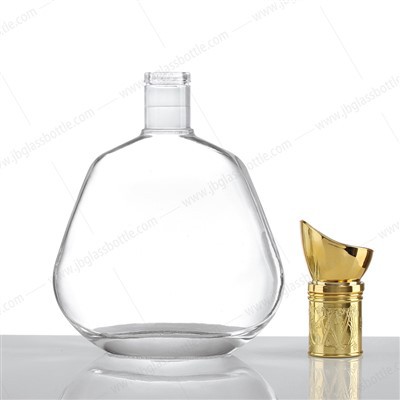

Collection of Raw Material
Natural raw materials are used for manufacturing of brandy bottles and glass jars for packaging. These raw materials are Silica and Soda lime. These materials perform different functions like, soda is used for lowering the melting point of sand and lime helps in making the glass hard, shiny and durable. Cullet is broken glass which is obtained from the bottles rejected by manufacturers of glass bottles, from the recycling points, bottle banks or kerbside collection system. It is very beneficial in manufacturing of glass containers.
Preparation of Batch
The batch is prepared on a grinding machine. Raw material, cullet (shredded glass pieces) and decolourisers / colourisers are ground finely in a grinder. The next step is to properly weigh these ingredients in the correct proportions before mixing them together. The mixing of these ingredients is usually done in a mixer until a homogeneous mixture known as a batch or frit is obtained. Before being fed to the kiln, the batches are stored in large vertical silos. The batch is now taken for further process of melting in a furnace.
Melting in Furnace
The mixture continues to melt in a furnace heated to a temperature of about 1748 °C. The furnace operates 24 hours a day, 7 days a week and has a service life of approximately 1012 years. The raw material entering the furnace turns into glass containers in about a day. Molten glass is delivered to the forming machine through a series of distribution channels called forehearths. At the end of the forehearths, the flow of glass is cut into pieces that are tightly controlled by weight, shape and temperature.
Forming at Present
Manufacturing of brandy bottles is done by two methods: B&B (Blow and Blow) process and NNPB (Narrow Neck Press and Blow) process. Both processes involve cutting a stream of molten glass with a cutting blade at a temperature of about 1,050–1,200 °C to form a rigid glass cylinder commonly referred to as a gob.
Please note that the gob is of predetermined weight, which is sufficient for manufacturing of glass bottle. Both B&B and NNPB processes start with the falling of gob, by gravity, and are guided through chutes, into the blank moulds, Two halves of moulds are clamped shut and then sealed by the baffle from above. However, in the B&B process, the parison is blown while in the latter, pressing forms the glass container parison.
Annealing
To ensure the strength of a newly formed glass vessel, it must be heat treated and subjected to controlled and uniform cooling in a tunnel kiln known as an “annealing lehr”. This can take anywhere from 30 minutes to 2 hours. If the cooling is uneven, the load will weaken the glass. An annealing oven commonly known in the industry as a lehr heats the vessel to about 580°C and then cools it down for 20-60 minutes, depending on the thickness of the glass.
The Lehr is a moving conveyor with different temperature zones. To make glass bottles and glass jars more scratch-resistant, they are usually treated with a hot applied top coat before entering the lehr and an additional coating as it cools as it leaves the lehr. This completes the glass container manufacturing process.
Coatings
Usually there are two surface coatings done on glass bottles and glass jars. The first one is done before annealing, at the hot end and the other one happens at the cold end, right after annealing.
A thin layer of tin oxide is applied to the hot end using a safe organic compound or inorganic stannic chloride. The tin-based systems are not the only solution, but they are the most widely used. Besides these, titanium tetrachloride or organo titanate can also be used. However, in all cases the coating makes the glass surface better adhere to the cold end coating. On the cold end, a layer of polyethylene wax is usually applied via an aqueous emulsion.
They are also coated to prevent the containers from sticking together as they move along the conveyor. In other words, the coating gives the glass a virtually scratch-resistant surface. It is basically made of special glass. As a result of reducing surface damage during use, coatings are often described as hardening and less commonly as retaining strength coatings.
Quality Inspection Machines
Glass containers are 100% checked for the presence of various defects, both automatically and manually.
The defects of glass containers can be of various different kinds. The glass can have small cracks called checks, and sometimes foreign objects called stones can penetrate the walls of the glass container.
Other defects include air bubbles (i.e. bubbles in the glass) and unnecessarily thin walls. Another common defect in glass container manufacturing is called a tear. In the press and blow method, if the plunger and the mould are misaligned or if they are not heated to the correct temperature, the glass will stick to the object and break.
In addition to rejecting defective containers, the inspection equipment also collects and transmits statistical information from the hot end to the operator of the forming machine. Computer systems collect misinformation and track down the mould the glass container was made from. This is possible by reading the mould number of the container coded on the container by the mould that made it. Any containers that do not meet the standards are automatically rejected and returned to the furnace for remelting.
Secondary Processing
Glass container manufacturers also offer additional services such as labelling. Although several marking options are available, the unique technology for glass is the Applied Ceramic Marking (ACL) process. At the same time, screen-printed decorations are applied to the container with glass enamel paint and then baked. Coca-Cola’ s original bottle is a well-known example of this.
Packaging
Glass containers are packaged differently. Bulk pallets, for example, are very popular in Europe, which can hold between 1,000 and 4,000 containers each. Automatic machines (eg palletizers, line and stack containers separated by sheet layers). Other options include boxes and hand-sewn bags. Once packed, new “in-stock items” are tagged, stored in a warehouse, and finally shipped. Glass jar manufacturers in India use shrink and carton boxes are the most used for glass jar and glass bottle packaging.
Our Factory
Shandong Jingbo Glass Co., Ltd Yuncheng County glass industry only registered her, like a bright pearl was born in Shuihu hometown --- Yuncheng earth, he marked the China glass high-end technology and to a new level.
The crystal glass company in Shandong province is the first professional production of high-end handmade crystal glass white material, high white material mechanism of glass bottles, glass cover, lighting lamps, perfume bottles, pots, cups and all kinds of high-end glass manufacturers, she with a high starting point, high quality, won the new and old customers.

Company Certificate
Our plants certified with ISO 9001: 2015, so do approved tests by SGS.

Asked Questions
Q: What is the function of a brandy bottle?
Q: What are the 3 cycles of brandy bottle?
Q: How are brandy bottles made?
Q: What are the facts about brandy bottles?
Q: Why is glass used in brandy bottles?
Q: How are brandy bottle recycled?
Q: How do you check the quality of a brandy bottle?
Q: Where are brandy bottles made from?
Q: Why are brandy bottles shaped?
Q: Are glass brandy bottles safer?
Q: Why are glass brandy bottles expensive?
Q: Can you reuse brandy bottles?
Q: What can you do with old brandy bottles?
Glass Bottle Light fittings. ...
Bottle Herb Planters. ...
Candles. ...
Soap Dispenser. ...
Wine Bottle Bird Feeder. ...
Gin Bottle Lamp. ...
Seedling Plant Protectors.
Q: How do you know if a brandy bottle is reusable?
Q: What is the ideal brandy bottle material?
Q: How are brandy bottles made?
Q: What are brandy bottles used for?
Q: What is the best shape for a brandy bottle?
Q: What are bottles made of?
Q: What is the hole in a brandy bottle called?
We're well-known as one of the leading brandy bottle manufacturers and suppliers in China. Please rest assured to wholesale bulk high quality brandy bottle at competitive price from our factory. Contact us for customized service.
750ml Brandy Glass Bottle, Brandy Bottle, 700ml Brandy Glass Bottle