


Clear Glass Bottle
Description
Technical Parameters
What is Clear Glass Bottle
A clear glass bottle is a bottle made from glass. Glass bottles can vary in size considerably, but are most commonly found in sizes ranging between about 200 millilitres and 1.5 litres. Common uses for clear glass bottle include food condiments, soda, liquor, cosmetics, pickling and preservatives.
Benefits of Clear Glass Bottle
Durability of glass bottles:Glass is a very durable material that can withstand high temperatures and pressure. This makes it ideal for liquids that can be affected by changes in temperature and humidity. Glass bottles are also resistant to scratches and dents, ensuring that the product inside remains protected.
Transparency:This allows consumers to see the product inside before they buy it. This is important for spirits, liquors, and wines, as consumers often want to look at the color, clarity, and viscosity of the product before making a purchase. Similarly, transparent glass bottles allow the product to be displayed on shelves and in bars, showcasing the brand and product to potential customers.
Glass bottle hygiene:Glass bottles are naturally hygienic, and free from chemicals and unwelcome contaminants. This is a crucial factor for selecting the packaging of food and beverages. Unlike other materials, such as plastic, glass bottles do not absorb odors or flavors from the product inside. And they also serve as a barrier to unhygienic elements in the outside world. Glass bottles are easy to clean and sanitize, making them an ideal choice for consumable liquids.
Glass bottles and preservation of flavour & qualities:Glass bottles are ideal for preserving spirits and liquors, as they are impermeable to air and moisture, ensuring that the product's unique properties remain stable and consistent over time. If stored correctly, the strength, flavor, and aroma of the bottled beverages remain unchanged. Additionally, glass bottles can be sealed with air-tight corks or screw caps to prevent air from entering the bottle and oxidizing its contents.

Rum Glass Bottle With Cap is a work of art unmatched in the spirits packaging industry. This bottle, which is made of premium glass and has an exquisitely crafted cap, embodies sophistication and elegance.

The Clear Glass Bottle is a versatile product that is made from high-quality glass materials and is perfect for a variety of uses. This product is widely used in the packaging and storage of various liquids, including beverages, cooking oils, and beauty products. Its high-quality construction ensures that it can withstand the rigors of everyday use.

The Alcohol Glass Bottle 700ml is a high-quality glass bottle designed to hold and store alcoholic beverages. Made from premium glass materials, this bottle is durable and provides a clear and transparent view of the contents inside.

The 700ml Rum Bottle is a high-end alcohol container with an elegant and luxurious style. Crafted from excellent materials, this rum bottle is ideal for serving, storing, and packaging fine rum and other drinks. With a 700 ml capacity, this clear glass rum bottle is perfect for giving or using for personal use.

This 700ml rum glass bottle is non-toxic, odorless, and has the advantages of heat resistance, pressure resistance, and cleaning resistance. It can be sterilized at high temperatures and stored at low temperatures.

1. Good sealing. No leakage when turned upside down, and the aroma of wine does not leak out.
2. Thickened material, high translucency glass, stable and durable
3. Glass material can be reused, saving resources, reducing the packaging cost of wine bottles, thereby reducing production costs.
Why Choose us
Our Products
The professional production of high-end handmade crystal glass white material, high white material mechanism of glass bottles, glass cover, lighting lamps, perfume bottles, pots, cups and all kinds of high-end glass manufacturers,
Our Company
Corporation registered capital of 58 million yuan, covers an area of more than 90 thousand square meters, has a subsidiary of 4. Is a research and development, design, production, sculpture, painting, baking and export as one of the integrated large-scale production enterprises.
Company Certificate
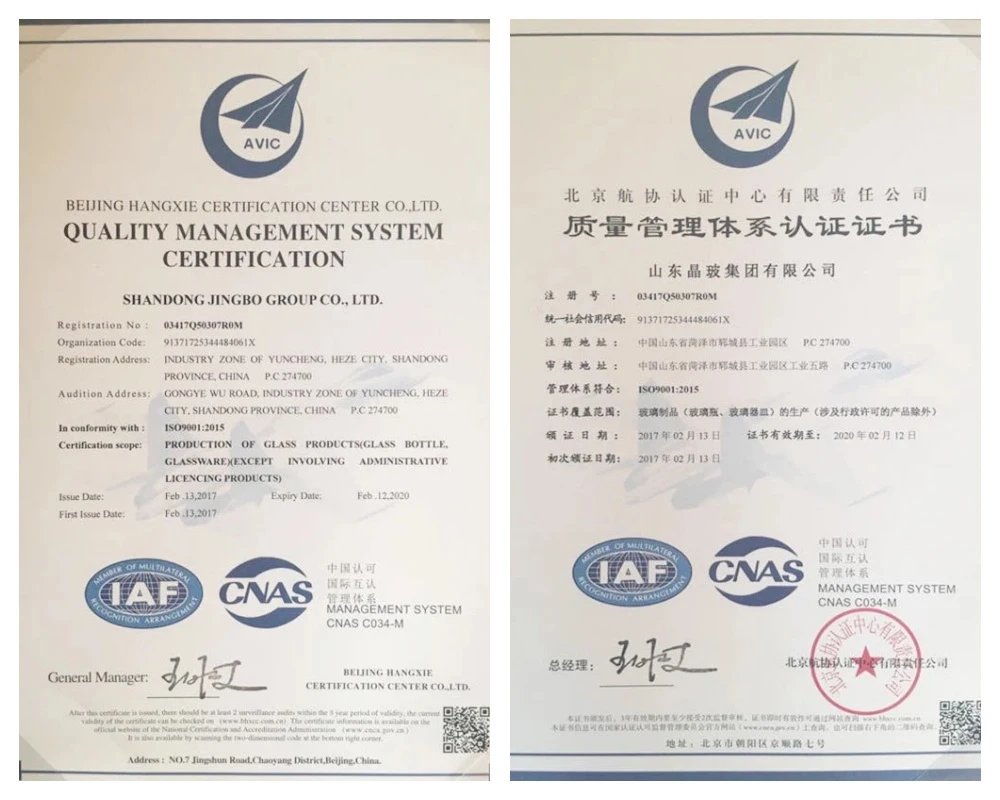
Our plants certified with ISO 9001: 2015, so do approved tests by SGS.
Customer Service
The design team will continue to understand your brand story, make a sketch that fits your idea, consider your cost, and improve the program to make the project progress smoothly.
The Different Types Of Glass Bottles
Green glass bottles
They are commonly used for storing wine because the green color helps protect the wine from harmful UV rays. They are also popular because they create an elegant and sophisticated appearance on store shelves. Additionally, the green color can help distinguish different types of wines based on the shade of green used. They are also recyclable and can be used to store other liquids.
Brown glass bottles
They are commonly used for storing beer because the brown color helps protect the beer from harmful UV rays that can alter the taste of the beer. Brown glass bottles are also popular because they create a classic and authentic appearance for craft beer brands. Moreover, the brown color can help differentiate different types of beers based on the shade of brown used. They are also recyclable and can be used to store other liquids.
Clear glass bottles
They are commonly used for storing spirits, water, fruit juices, milk, and soft drinks. Clear glass allows consumers to see the contents of the bottle, which can help create an attractive product aesthetic on store shelves. However, clear glass can be sensitive to UV rays, which can alter the quality of the contents if exposed to sunlight for an extended period.
For this reason, it's important to store them in a cool and dark place to avoid any damage. Clear glass bottles are also easy to recycle and are often used to store reusable products such as olive oils, vinegar, and sauces.
Clear Glass Bottle Manufacturing Process
Choosing the raw material
The clear glass bottles are generally made of 7 to 12 different kinds of materials, and the primary materials used in the glass bottle manufacturing process are silica sand, sodium carbonate, limestone, dolomite, feldspar, borax, barium, and so on.
The most important raw material is silica as it determines the strength of the glass. The amount of silica can be chosen based on the type of glass to be made. The silica content is important as the melting point of the glass is inversely proportional to it.
Batch house
The manufacturing of the glass is a continuous process, so the batching processes will also occur continuously. Here the raw materials will be weighed and mixed, and then transferred into the hopper which is at the melting furnace.
Initially, the raw materials are feed to the hopers where it will get mixed and then transferred it into the furnace. Sometimes the conveyor belt consists of a magnet that will remove the magnetic materials. Once the raw material is mixed well, then it is feed into the furnace continuously using the batch process so that the composition of the material will be the same for all the processes.
Melting
In the melting process, the batched materials will be fed into the furnace, and in the furnace, the raw materials will get heated and melted. The batch materials are heated at high temperatures and the average temperature is 15500 degrees to 16000 degrees. In the furnace, the raw material will form a liquid glass and it should be uniform, free of bubbles, and also that should come under the molding requirements. The melting temperature entirely depends on the composition.
Feeding
The next process is the feeding process, and in this stage, the glassblowers will be feed. The feeding of the glass gob should be done at an optimum temperature. The temperature is chosen based on the weight and shape of the bottle. Then the glass is fed into the glass-bottle forming machine through the feeder.
The feeders will have an opening at the end, and low shear panels control this opening. The speed of the sheer mass can be controlled and if you need a big size glass then the sheer speed should be less.
Forming
Once the elongated shape has been cut from the furnace, then the next step is to get the shape of the bottle. In the forming process, the forming machine will transfer the garbs into the container. Once the garbs are placed inside the mold, now air is blown into the forming machine, so that the shape will be obtained.
Once the shape is formed, it is removed from the mold. If you need to join any other shape to the glass, then you need to do it at this step, or else the glass will become hard, and then you need to melt the glass again.
Annealing
Once the glass is removed from the glass forming machine, then the next step is annealing. The annealing process is required, as it will remove the stress, phase separation, or crystallization inside the glass. During this stage, the structural state of the glass will get changed.
The stress is caused mainly as the outer surface of the glass gets cooled rapidly than the interior side. The annealing process will help to cool both the inside and outside of the glass evenly to avoid any stress in the glass. This will also help to prevent the crack in the glass, and make the bottle stronger.
Inspection
Inspection is the most important step as it will help to find out the quality of the glass. Only the glass bottle which has been passed the inspection will be taken for the next level, and others that didn't pass the inspection will be carried to the glass manufacturing process called cullet.
The inspection is done at various levels, and in some cases, both manual and automatic inspection will be done to ensure a high-quality product to the customers. During the inspection, the size, shape, and defects will be checked, and the most common defects will be cracks, pinholes, contamination, and air trapped inside the bottles.
Packing and Shipment
Based on the customer's requirement, the bottle will be packed accordingly. Also, the bottles are packed according to the destination, and then they will be stored in the warehouse or will get shipped to the customers.
The glass bottles will be wrapped in a cardboard box, and this box will contain multiple segments that have been separated by corrugated sheets. Mostly, the packaging will be an automatic process, so that any kind of damage can be avoided.
Main Raw Materials Of Clear Glass Bottle Introduction And Usage


1. Quartz powder: It is a hard, wear-resistant, chemical stability of minerals, the main mineral component is quartz, main chemical ingredient is SiO2. Quartz powder is milk white or colorless translucent, hardness is 7, brittle, no cleavage, conchoidal fracture, oil sheen, density of 2.65, doesn't dissolve in acid. Main usages: filter material, high grade glass, glass product, refractory, smelting stone, precision casting, sand blasting, grinding wheels materials, etc.
2. Limestone: Calcium carbonate is the main component of limestone. Limestone is the main raw material of glass. Lime and limestone mass used as building materials, they are important raw material in many industries. Calcium carbonate can be directly processed into stone and fired into quicklime.
3. Sodium carbonate: It is one of the important chemical raw materials, widely used in light industry, building materials, chemical industry, food industry, metallurgy, textiles, petroleum, national defense, medicine, etc. It is used as the raw materials, cleaning agents, detergents in the manufacturing of other chemicals, but also the field of photography and analysis.
4. Dolomite: It can be used as reformer refractory inner layer in steelmaking, slagging constituent, raw material of cement, fusing agent of glass, ceramic, fertilizer, building and decorative stone, paint, pesticide, medical, etc. It can be used in building material, ceramic, glass and refractory material, chemical industry and agriculture, environmental protection, energy saving fields.
5. Feldspar: one common aluminosilicate rock-forming mineral which contains calcium, sodium and potassium. There are 60% of feldspar in the crust, it occur in igneous, metamorphic, sedimentary rocks. Main usages: the manufacture of ceramic and porcelain enamel, raw materials of glass, abrasive, etc. It also can be used to produce potash fertilizer.
6. Boric acid: Soluble in water, alcohol, glycerin, ether and essential oil. Aqueous solution presents weak acid. Mass used in glass (optical glass, acid-resistant glass, heat-resistant glass, glass fiber used in insulation) industry, boric acid can improve glass products' heat-resistant, transparent performance, and mechanical strength, it also can shorten the melt time.
7. Sodium sulfate: The main composed of sodium sulfate is Na2SO4 that a raw material imports from Na2O. Mainly used to remove SiO2 scum, play the role of a clarifying agent
8. Barium sulfate: Odorless, tasteless and colorless orthorhombic crystals or a white amorphous powder, property stable, insoluble in water, acids, alkali or organic solvents. It can be used as raw material or filler of paint, ink, plastics, rubber and battery materials in industry. In glass products it used as a clarifying agent, can play the role of anti-foaming and increasing gloss. It also used in ceramics, enamel, spices and pigments industries. It is the raw material for producing other barium salts.
9. Zinc oxide: Zinc oxide ZnO can increase chemical stability of sodium - calcium silicon glass and reduce its tendency to crystallize.
10. Potassium carbonate: Used in glass, printing and dyeing, soap, enamel, preparing sylvite, synthesis ammonia decarbonylation, color TV industry, in food as a leavening agent, adsorbents for gas, powder extinguishing agent, rubber antioxidant, etc.
11. Cullet: Most manufacturing process using 20% -30% of the cullet to facilitate melting and optimum mixing with quartz sand, feldspar and alkali, but also can improve the utilization of recycled glass, for saving energy and enhance environmental protection.
Neck - The section of the clear glass bottle that is above the shoulder. The neck includes the Neck Finish, Satellite Ring, Mouth, and the Sealing Surface.
Neck Finish - The top part of the clear glass bottle or jar, above the neck. Containing the spiral threads. The length, thickness and Pitch of the threads determine the standard classification of the Neck Finish.. To learn more, see our post How To Measure the Neck Finish of your Bottle or Cap.
Sealing Surface - The flat, top area around the Mouth of the Neck Finish. This surface makes direct contact with the liner in the closure to form a seal.
Mouth - The inner diameter of the opening in the neck. Some clear glass bottles and jars have mouths that are nearly the same diameter as the container itself. These are called "Wide Mouth" containers.
Satellite Ring - A ring molded into the neck of the bottle or jar at the base of the finish. Essentially designed to provide a handle for the manufacturing machinery during production. The Satellite Ring can also play a key role in helping to seal in the contents of the bottle when shrink wrap is applied over the ring and closure together.
Shoulder - The part of the bottle that joins the wider, main body, and the narrower neck. The "slope" or "curve" of the shoulder can have a significant effect on how quickly a product will pour out of the bottle.
Body/Sidewalls - The main part (sidewalls) of the clear glass bottle. This area also contains the label panel.
Label Panel/Area - Most bottles have a designated area on the body that will accept an adhesive, printed label. Sometimes bottles are designed with a recessed label area to protect the labels from rubbing during shipping and storage.
Bottom Plate - The entire lower part of the bottle below the sidewalls. The bottom includes the Heel, Base and Pushup.
Heel - The lower curve of the clear glass bottle where the Body (Sidewall) meets the Base.
Base - An extruded ring around the inside diameter of the Bottom Plate that provides a more secure surface for the bottle to rest.
Pushup - A concave, dome-shaped, indentation on the inside of the Base on the Bottom Plate. The pushup can range from just a slight concave, to a significantly deep one. Grab a plastic sports drink or a glass bottle of wine and take a look. These products typically have very deep pushups at their base. The pushup can help prevent the bottle from rocking.
Registration Marks - Small indentations on the Bottom Plate designed as registration and grappling points for a printer to line up the bottle when silk screening.
Recycling Symbol - The recycling number will indicate the type of plastic the clear glass bottle is made from. It doesn't always indicate that the bottle can be recycled. Each municipalities determine what bottles they recycle.
Our Factory
Shandong Jingbo Glass Co., Ltd Yuncheng County glass industry only registered her, like a bright pearl was born in Shuihu hometown --- Yuncheng earth, he marked the China glass high-end technology and to a new level.
The crystal glass company in Shandong province is the first professional production of high-end handmade crystal glass white material, high white material mechanism of glass bottles, glass cover, lighting lamps, perfume bottles, pots, cups and all kinds of high-end glass manufacturers, she with a high starting point, high quality, won the new and old customers.

Company Certificate
Our plants certified with ISO 9001: 2015, so do approved tests by SGS.
Asked Questions
Q: What are some interesting facts about clear glass bottle?
Glass is made of Silica, soda ash, and limestone. ...
Glass bottles and jars are non-porous. ...
If you compare today's glass containers with the glass containers of two decades ago, you will realize that today's glass bottles weigh almost half what they did then.
Q: When were clear glass bottle invented?
Q: Why was a transparent glass bottle used?
Q: Why are some glass bottles colored instead of clear?
Q: How was clear glass discovered?
Q: Is a clear glass bottle transparent?
Q: What is the oldest glass bottle ever found?
Q: What are transparent bottles made of?
Q: What are transparent water bottles made of?
Q: Why does clear glass turn purple?
Hot Tags: clear glass bottle, China clear glass bottle manufacturers, suppliers, factory, Clear Glass Bottle, 700ml Rum Glass Bottle, 700ml Rum Bottle, Rum Bottle, Rum Glass Bottle with Cap, Alcohol Glass Bottle 700ml
Previous
Round Mouth 700ml Rum BottleSend Inquiry


